Sunday, August 7, 2011

Aug 7, 2011

Optional Memorial
St. Sixtus II, Pope and Martyr and Comapnions, Martyrs

Optional Memorial (1969 Calendar): August 7

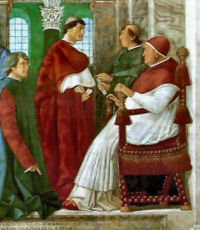
Today is the Optional Memorial of St. Sixtus II, who was pope from August 30, 257 - August 6, 258 AD, following Pope Stephen I. Even though his reign was short, he restored relations with the African and Eastern churches following strained relations under Pope Stephen I. The issue that caused the dispute was the rebaptism of heretics. Pope St. Sixtus II believed that anyone who was baptised with a desire to be a Christian, even if the Baptism was performed by a heretic, was truly baptised into the faith; the validity of his faith was based on his own desire and actions, not the errors of the person who performed the sacrament. Thankfully, St. Sixtus II restored relations with the churches that disagreed with Rome. Remember, at this time all churches still remained in union with Rome - the Holy Catholic Church.

Yet, not one year after his elevation to the papacy, he was beheaded by order of Emperor Valerian I in 258. Emperor Valerian I had issued a decree shortly before the pontificate of Sixtus II forbidding Chrisitians to gather in cemeteries and demanding them to worship pagan gods. In early August 258, Emperor Valerian ordered the excecution of priests, bishops, and deacons. Pope Sixtus II was one of the first victims of the persecutions by Emperor Valerian I. Four deacons, Januarius, Vincentius, Magnus, and Stephanus, were apprehended at the same cemetery as Pope Sixtus II and beheaded. Pope Sixtus II was beheaded in his chair, which was later enshrined behind his tomb. Two other deacons, Felicissimus and Agapitus, were martyred the same day. Today we remember Sts. Sixtus II and his 6 companions that died for the Faith.

Before Pope St. Sixtus II was martyred, his deacon St. Lawrence, came to him:

St. Lawrence said: "Father, where are you going without your son? Where are you hastening, O priest, without your deacon? Never before did you offer the holy Sacrifice without assistants. In what way have I displeased you? In what way have you found me unfaithful in my office? Oh, try me again and prove to yourself whether you have chosen an unworthy minister for the service of the Church. So far you have been trusting me with distributing the Blood of the Lord." To this Pope Sixtus II replied, "I am not forsaking you, my son; a severer trial is awaiting you for your faith in Christ. The Lord is considerate toward me because I am a weak old man. But for you a most glorious triumph is in store. Cease to weep, for already after three days you will follow me" 

http://acatholiclife.blogspot.com/2006/08/pope-st-sixtus-ii-and-companions.html

Saturday, August 6, 2011

Aug 7, 2011

St. Cajetan, Priest


Daily Prayer

Prayer O glorious St. Cajetan, you studied to be a lawyer, but when you felt that the Lord was calling you to his service, you abandoned everything and became a priest. You excelled in virtues, shunning all material rewards for your labor, helping the many unemployed people of your time. You provided loans without interest and you attracted a lot of benefactors who donated to your resources so that you could go on with your activities. Look on us with mercy. We wish to find employment that could help us and our families live with dignity. Listen to our petitions, dear saint; you who could easily give up the food on your table for the needy, bring our petitions to Jesus (here mention your petition), AMEN


Founder of the Theatines, born October, 1480 at Vicenza in Venetian territory; died at Naples in 1547. Under the care of a pious mother he passed a studious and exemplary youth, and took his degree asdoctor utriusque juris at Padua in his twenty-fourth year. In 1506 he became at Rome a prothonotaryApostolic in the court of Julius II, and took an important share in reconciling the Republic of Venicewith that pontiff. On the death of Julius in 1523 he withdrew from the court, and is credited with founding, shortly after, an association of pious priests and prelates called the Oratory of Divine Love, which spread to other Italian towns. Though remarkable for his intense love of God, he did not advance to the priesthood till 1516. Recalled to Vicenza in the following year by the death of his mother, he founded there a hospital for incurables, thus giving proof of the active charity that filled his whole life. But his zeal was more deeply moved by the spiritual diseases that, in those days of political disorder, infected the clergy of all ranks, and, like St. Augustine in earlier times, he strove to reform them by instituting a body of regular clergy, who should combine the spirit of monasticism with the exercises of the active ministry.
Returning to Rome in 1523 he laid the foundations of his new congregation, which was canonicallyerected by Clement VII in 1524. One of his four companions was Giovanni Pietro Caraffa, Bishop ofChieti (in Latin Theate), afterwards Paul IV, who was elected first superior, and from whose title arose the name Theatines. The order grew but slowly. During the sack of Rome in 1527 the Theatines, then twelve in number, escaped to Venice after enduring many outrages from the heretic invaders. ThereCajetan met St. Hieronymus Æmiliani (see SOMASCHI), whom he assisted in the establishment of hisCongregation of Clerks Regular. In 1533 Cajetan founded a house in Naples, where he was able to check the advances of Lutheranism. In 1540 he was again at Venice, whence he extended his work toVerona and Vicenza. He passed the last four years of his life, a sort of seraphic existence, at Napleswhere he died finally of grief at the discords of the city, suffering in his last moments a kind ofmystical crucifixion. He was beatified by Urban VIII in 1629, and canonized by Clement X in 1671. Hisfeast is kept on the 7th of August.


Friday, August 5, 2011

August 6, 2011

TRANSFIGURATION 


The Transfiguration of Christ is the culminating point of His public life, as His Baptism is its starting point, and His Ascension its end. Moreover, this glorious event has been related in detail by St. Matthew (17:1-6), St. Mark (9:1-8), and St. Luke (9:28-36), while St. Peter (2 Peter 1:16-18) andSt. John (1:14), two of the privileged witnesses, make allusion to it.
About a week after His sojourn in Cæsarea PhilippiJesus took with him Peter and James and John and led them to a high mountain apart, where He was transfigured before their ravished eyes. St. Matthewand St. Mark express this phenomenon by the word metemorphothe, which the Vulgate renderstransfiguratus est. The Synoptics explain the true meaning of the word by adding "his face did shine as the sun: and his garments became white as snow," according to the Vulgate, or "as light," according to the Greek text.
This dazzling brightness which emanated from His whole Body was produced by an interior shining of His Divinity. False Judaism had rejected the Messias, and now true Judaism, represented by Moses andElias, the Law and the Prophets, recognized and adored Him, while for the second time God the Fatherproclaimed Him His only-begotten and well-loved Son. By this glorious manifestation the Divine Master, who had just foretold His Passion to the Apostles (Matthew 16:21), and who spoke with Moses andElias of the trials which awaited Him at Jerusalem, strengthened the faith of his three friends and prepared them for the terrible struggle of which they were to be witnesses in Gethsemani, by giving them a foretaste of the glory and heavenly delights to which we attain by suffering.

Location of the Transfiguration

Already in Apostolic times the mount of the Transfiguration had become the "holy mount" (2 Peter 1:18). It seems to have been known by the faithful of the country, and tradition identified it withMount ThaborOrigen said (A.D. 231-54) "Thabor is the mountain of Galilee on which Christ was transfigured" (Comm. in Ps. lxxxviii, 13). In the next century St. Cyril of Jerusalem (Catechetical Lectures II.16) and St. Jerome (Epistles 4653 and 108) likewise declare it categorically. Later St. ProculusPatriarch of Constantinople (d. 447; Orat. viii, in Transfig.), Agathangelus (Hist. of Armenia, II, xvii), and Arnobius the Younger (d. 460; Comm. in Ps. lxxxviii, 13) say the same thing. The testimonies increase from century to century without a single dissentient note, and in 553 the Fifth Council of Constantinople erected a see at Mount Thabor (Notitif. Antioch. . . . patriarch.).
Some modern writers claim that the Transfiguration could not have taken place on Mount Thabor, which, according to Josephus, was then surmounted by a city. This is incorrect; the Jewish historian speaks neither of a city nor a village; he simply fortified, as he repeats three times, "the mount called Itabyrion" ("Bell. Jud.", II, xx, 6; IV, i, 8; Vita, 37). The town of Atabyrion of Polybius, the Thabor or Celeseth Thabor, the "flank of Thabor" of the Bible, is situated at the foot of Mount Thabor. In any case the presence of houses on a wooded height would not have made it impossible to find a place apart.
It is again objected that Our Lord was transfigured on Mount Hermon, since He was at that time in its vicinity. But the Synoptics are all explicit concerning the lapse of time, six days, or about eight days including those of departure and arrival, between the discourse in Cæsarea and the Transfiguration, which would infer a somewhat lengthy journey. Moreover the summits of Hermon are covered with snow as late as June, and even the lesser peaks of 4000 or 5000 feet are likewise snow-covered in February and March, the period of the Transfiguration. Finally, the ancients judged of the height of mountains by their appearance, and Thabor especially was considered a "high mountain", if not byDavid and Jeremias, at least by Origen and St. Jerome and the pilgrims who made the ascent.


Thursday, August 4, 2011

August 5, 2011


DEDICATION OF SAINT MARY MAJORIN ROME
FEAST DAY:  AUGUST 5TH
 THERE are in Rome three patriarchal churches, in which the Pope officiates on different festivals. These are the Basilics of St. John Lateran, St. Peter's on the Vatican Hill, and St. Mary Major. This last is so called because it is, both in antiquity and dignity, the first church in Rome among those that are dedicated to God in honor of the Virgin Mary. The name of the Liberian Basilic was given it because it was founded in the time of Pope Liberius, in the fourth century; it was consecrated, under the title of the Virgin Mary, by Sixtus III., about the year 435. It is also called St. Mary ad Nives, or at the snow, from a popular tradition that the Mother of God chose this place for a church under her invocation by a miraculous snow that fell upon this spot in summer, and by a vision in which she appeared to a patrician named John, who munificently founded and endowed this church in the pontificate of Liberius. The same Basilic has sometimes been known by the name of St. Mary ad Prasepe, from the holy crib or manger of Bethlehem, in which Christ was laid at his birth. It resembles an ordinary manger, is kept in a case of massive silver, and in it lies an image of a little child, also of silver. On Christmas Day the holy manger is taken out of the case, and exposed. It is kept in a sumptuous subterraneous chapel in this church.

REFLECTION.—To render our supplications the more efficacious, we ought to unite them in spirit to those of all fervent penitents and devout souls, in invoking this advocate for sinners.

INTERCESSORY PRAYER:  On this Feast of this Basilica dedicated to the Blessed Mother, let us ask Our Lady to intercede for our needs.  Dear Blessed Mother, please pray for (Prayer Request).


__________________________________________________________________________________


The Dedication of Saint Mary Major, previously known as Dedicatio Sanctæ Mariæ ad Nives (Dedicationof the Church of Our Lady of the Snows), is a liturgical feast day celebrated on August 5 in the Latin Rite of the Catholic Church. In the Roman Catholic calendar of saints it has the rank of optional memorial, and in the General Roman Calendar of 1962 it is third-class feast. It commemorates the dedication of the restoredBasilica di Santa Maria Maggiore by Pope Sixtus III just after the First Council of Ephesus. This majorbasilica, located on the summit of the Esquiline Hill in Rome, is called the Basilica of Saint Mary Major(LatinBasilica Sancta Mariæ Majoris) because it is the largest church in Rome dedicated to the Blessed Virgin Mary.
The church was originally built during the pontificate of Pope Liberius, and is thus sometimes known as the"Basilica Liberii" or "Basilica Liberiana".


History


The Miracle of the Snow byMasolino da Panicale.
Pope Pius V inserted this feast into the General Roman Calendar in 1568, when, in response to the request of the Council of Trent, he reformed the Roman Breviary. Before that, it had been celebrated at first only in the church itself and, beginning in the fourteenth century, in all the churches of the city of Rome.
It thus appears in the Tridentine Calendar for celebration as a Double. InPope Clement VIII's Missal of 1604, it was given the newly invented rank of Greater Double. In Pope John XIII's classification it became a Third-Class Feast. This 1960 calendar, included in the 1962 edition of theRoman Missal, is the calendar whose continued use privately and, under certain conditions, publicly is authorized by the motu proprioSummorum Pontificum. Nine years later, the celebration became an optional Memorial.
Until 1969 the feast was known as Dedicatio Sanctæ Mariæ ad Nives (Dedication of the Church of Our Lady of the Snows), a name that had become popular for the Basilica in the fourteenth century in connection with a legend about its origin that the Catholic Encyclopedia summarizes: "During the pontificate of Liberius, the Roman patrician John and his wife, who were without heirs, made a vow to donate their possessions to the Virgin Mary. They prayed that she might make known to them how they were to dispose of their property in her honour. On 5 August, at the height of the Roman summer, snow fell during the night on the summit of the Esquiline Hill. In obedience to a vision of the Virgin Mary which they had the same night, the couple built a basilica in honour of Mary on the very spot which was covered with snow. From the fact that no mention whatever is made of this alleged miracle until a few hundred years later, not even by Sixtus III in his eight-line dedicatory inscription ... it would seem that the legend has no historical basis."
The Encyclopedia also informs that, in 1741, a congregation set up by Pope Benedict XIV proposed that the reading of the legend be removed from the Roman Breviary and that the original name, "Dedicatio Sanctæ Mariæ", be restored. This recommendation was implemented only in 1969.

Wednesday, August 3, 2011

August 4, 2011

St. John Vianney, Priest


What a day to pray for vocations to the priesthood! Today is the feast day of Saint John Vianney, the patron saint of priests. What an inspiration that holy man is, with so many churches and schools world wide named for him.
Universally known as the “Cure of Ars,” St. John Mary Vianney was ordained a priest in 1815. Three years later he was made parish priest of Ars, a remote French hamlet, where his reputation as a confessor and director of souls made him known throughout the Christian world. His life was one of extreme mortification.
Accustomed to the most severe austerities, beleaguered by swarms of penitents, and besieged by the devil, this great mystic manifested a imperturbable patience. He was a wonder worker loved by the crowds, but he retained a childlike simplicity, and he remains to this day the living image of the priest after the heart of Christ.
He heard confessions of people from all over the world for the sixteen hours each day. His life was filled with works of charity and love. It is recorded that even the staunchest of sinners were converted at his mere word. He died August 4, 1859, and was canonized May 31, 1925.


Tuesday, August 2, 2011

August 3, 2011

Prayer to Saint John Vianney for Parish Priests


Dear Saint John Vianney, your childhood dream was to be a priest, to win souls for God. You endured years of toil and humiliation to attain the priesthood. You became a priest truly after God's own heart, outstanding in humulity and poverty, prayer and mortification. Totally devoted to the service of God's people. The Church has exalted you as model and patron saint of all Parish Priest, trusting that your example and prayers will help them to live up to the high dignity of their vocation to be faithful servants of God's people, to be perfect imitators of Christ the Savior Who came not to be served but to serve, to give His Life in ransom for many.
Pray that God may give to His Church today many more priests after His own heart. Pray for all the priests under your patronage, that they may be worthy representatives of Christ the Good Shepherd. May they wholeheartedly devote themselves to prayer and penance; be examples of humility and poverty; shining modelss of holiness; tireless and powerful preachers of the Word of God; zealous dispensers of God's Grace in the sacraments. May their loving devotion to Jesus in the Eucharist and to Mary His Mother be the Twin Fountains of fruitfulness for their ministry.
Amen


Monday, August 1, 2011

August 2, 2011

St. Eusebius of Vercelli


Bishop of Vercelli, b. in Sardinia c. 283; d. at VercelliPiedmont, 1 August, 371. He was made lector inRome, where he lived some time, probably as a member or head of a religious community (Spreitzenhofer, Die Entwickelung des alten Mönchtums in Italien, Vienna, 1894, 14 sq.), Later he came to Vercelle, the present Vercelli, and in 340 was unanimously elected bishop of that city by theclergy and the people. He received episcopal consecration at the hands of Pope Julius I on 15 December, of the same year. According to the testimony of St. Ambrose (Ep. lxiii, Ad Vercellenses) he was the first bishop of the West who united monastic with clerical life. He led with the clergy of his city a common life modelled upon that of the Eastern cenobites (St. Ambrose, Ep. lxxxi and Serm. lxxxix). For this reason the Canons Regular of St. Augustine honour him along with St. Augustine as their founder (Proprium Canon. Reg., 16 December).
In 364 Pope Liberius sent Eusebius and Bishop Lucifer to Cagliari to the Emperor Constantius, who was then at Arles in Gaul, for the purpose of inducing the emperor to convoke a council which should put an end to the dissentions between the Arians and the orthodox. The synod was held in Milan in 355. At first Eusebius refused to attend it because he foresaw that the Arian bishops, who were supported by the emperor, would not accept the decrees of the Nicene council and would insist upon the condemnation of St. Athanasius. Being pressed by the emperor and the bishops to appear at thesynod, he came to Milan, but was not admitted to the synod until the document condemning St. Athanasius had been drawn up and was awaiting the signature of the bishops. Eusebius vehemently protested against the unjust condemnation of St. Athanasius and, despite the threats of the emperor, refused to attach his signature to the document. As a result he was sent into exile, first toScythopolis in Syria, where the Arian bishop Patrophilus, whom Eusebius calls his jailer, (Baronius, Annal., ad ann. 356, n. 97), treated him very cruelly; then to Cappodocia, and lastly to Thebaid. On the accession of the Emperor Julian, the exiled bishops were allowed to return to their sees, in 362.Eusebius, however, and his brother-exile Lucifer did not at once return to Italy. Acting either by force of their former legatine faculties or, as is more probable, having received new legatine faculties fromPope Liberius, they remained in the Orient for some time, helping to restore peace in the Church.Eusebius went to Alexandria to consult with St. Athanasius about convoking the synod which in 362 was held there under their joint presidency. Besides declaring the Divinity of the Holy Ghost and theorthodox doctrine concerning the Incarnation, the synod agreed to deal mildly with the repentantapostate bishops, but to impose severe penalties upon the leaders of several of Arianizing factions. At its close Eusebius went to Antioch to reconcile the Eustathians and the Meletians. The Eustathians were adherents of the bishop St. Eustatius, who was deposed and exiled by the Arians in 331. SinceMeletius' election in 361 was brought about chiefly by the Arians, the Eustathians would not recognize him, although he solemnly proclaimed his orthodox faith from the ambo after his episcopalconsecration. The Alexandrian synod had desired that Eusebius should reconcile the Eustathians withBishop Meletius, by purging his election of whatever might have been irregular in it, but Eusebius, upon arriving at Antioch found that his brother-legate Lucifer had consecrated Paulinus, the leader of the Eustathians, as Bishop of Antioch, and thus unwittingly had frustrated the pacific design. Unable to reconcile the factions at Antioch, he visited other Churches of the Orient in the interest of theorthodox faith, and finally passed through Illyricum into Italy. Having arrived at Vercelli in 363, he assisted the zealous St. Hilary of Poitiers in the suppression of Arianism in the Western Church, and was one of the chief opponents of the Arian Bishop Auxientius of Milan. The church honours him as amartyr and celebrates his feast as a semi-double on 16 December. In the "Journal of Theological Studies" (1900), I, 302-99, E.A. Burn attributes to Eusebius the "Quicumque". (See ATHANASIAN CREED)
Three short letters of Eusebius are printed in Migne, P.L., XII, 947-54 and X, 713-14. St. Jerome(Illustrious Men 56 and Epistle 51, no. 2) ascribes to him a Latin translation of a commentary on thePsalms, written originally in Greek by Eusebius of Cæsarea; but this work has been lost. There is preserved in the cathedral at Vercelli the "Codex Vercellensis", the earliest manuscript of the old LatinGospels (codex a), which is generally believed to have been written by Eusebius. It was published byIrico (Milan 1748) and Bianchini (Rome, 1749), and is reprinted in Migne, P.L. XII, 9-948; a new edition was brought out by Belsheim (Christiania, 1894). Krüger (Lucifer, Bischof von Calaris", Leipzig, 1886, 118-30) ascribes to Eusebius a baptismal oration by Caspari (Quellen sur Gesch, Des Taufsymbols, Christiania, 1869, II, 132-40). The confession of faith "Des. Trinitate confessio", P.L., XII, 959-968, sometimes ascribed to Eusebius is spurious.